

Polyurethane elastomers are used in a solid state, and their mechanical properties under the action of various external forces are the most important indicators of their performance. In general, polyurethane elastomers and other polymers, its performance and molecular weight, intermolecular forces, toughness of the chain segment, crystallization tendency, branching and crosslinking, as well as the location of substituents, polarity and volume size and other factors have a close relationship, but polyurethane elastomers and hydrocarbon system (PP, PE, etc.) polymers are different. Its molecular structure is composed of soft segments (oligomer polyols) and hard segments (polyisocyanates, chain extender crosslinkers, etc.). The electrostatic force between macromolecules, especially between hard chain segments, is very strong, and a large number of hydrogen bonds are often generated. This strong electrostatic force effect, in addition to directly affecting mechanical properties, can also promote the aggregation of hard chain segments, resulting in microphase separation. Improve the mechanical properties and high and low temperature properties of elastomers.
The relationship between mechanical properties and structure
The mechanical properties of polyurethane elastomers depend on the crystallization tendency of polyurethane elastomers, especially the crystallization tendency of soft chain segments. However, polyurethane elastomers are used in a high elastic state, and crystallization is not expected. Therefore, it is necessary to find a balance between elasticity and strength through formulation and process design, so that the prepared polyurethane elastomers do not crystallize at the use temperature. It has good elasticity, and can rapidly crystallize at a high tensile level, and the melting temperature of this crystal is at room temperature, when the external force is removed, the crystal melts rapidly, this reversible crystal structure is very beneficial to improve the mechanical strength of polyurethane elastomers.
The reversible crystallization of polyurethane elastomers depends mainly on the polarity of the soft segments, molecular weight, intermolecular force and structure regularity. The molecular polarity and intermolecular forces of polyester are greater than those of polyether, so the mechanical strength of polyester polyurethane elastomer is greater than that of polyether polyurethane elastomer. The side group in the soft chain segment will reduce the crystallinity, which will reduce the mechanical properties of the product.
The structure of polyurethane hard chain segment also has direct and indirect influence on the mechanical properties of polyurethane elastomers. Generally, aromatic diisocyanates (such as diphenylmethane diisocyanate (MDI), toluene diisocyanate (TDI)) are larger than ester diisocyanates (such as hexamethylenediisocyanate (HDI)). The diisocyanate (such as MDI) with symmetrical structure can give higher hardness, tensile strength and tear strength to polyurethane elastomers. The effect of the structure of chain extension crosslinker on the mechanical properties of elastomer is similar to that of diisocyanate.
The relationship between heat resistance and structure
The thermal stability of polymers can be measured by softening temperature and thermal decomposition temperature. Under normal circumstances, the thermal decomposition temperature of polyurethane elastomers is lower than the softening temperature. Generally speaking, the heat resistance of polyester polyurethane elastomers is better than that of polyether polyurethane elastomers. For aromatic diisocyanates, the heat resistance order is: p-phenyl diisocyanate (PPDI)>1, 5-naphthalene diisocyanate (NDI)>MDI>TDI.
The relationship between low temperature performance and structure
The low temperature elasticity of polymers is usually measured by glass transition temperature and cold resistance coefficient (or embrittlement temperature). In general, the low temperature flexibility of polyether polyurethane elastomers is better than that of polyester elastomers.
Relationship between water resistance and structure
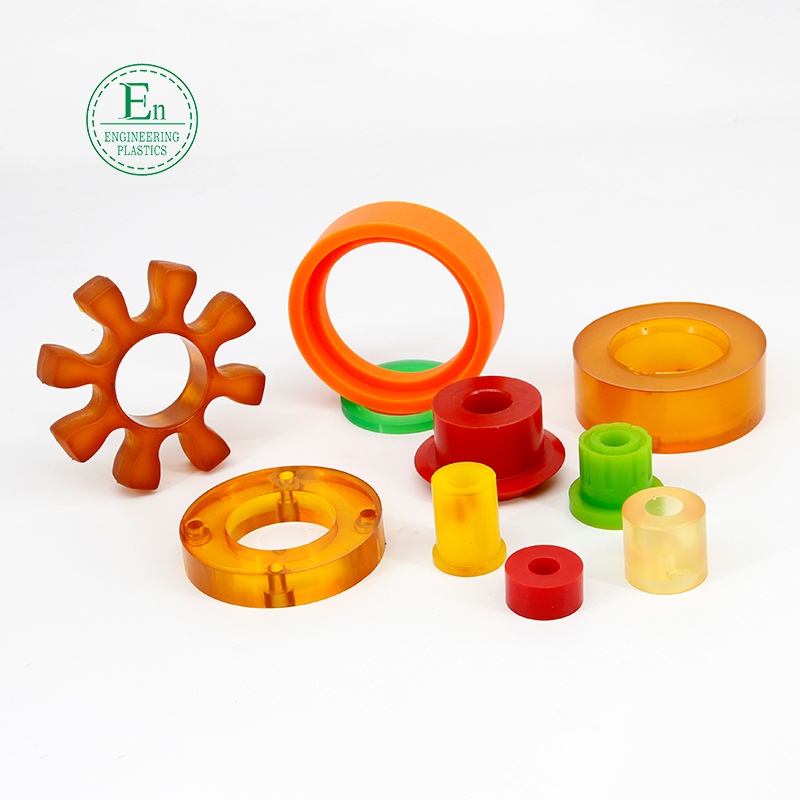
The effect of water on polyurethane elastomers: plasticizing effect (water absorption) and degradation effect of water. When the relative humidity is 100%, the water absorption of polyester polyurethane elastomer is about 1.1%, and the performance is reduced by about 10%. The water absorption rate of polyether polyurethane elastomer is about 1.4%, and the performance decreases about 20%. However, the hydrolysis stability of polyether polyurethane elastomers is greater than that of polyester polyurethane elastomers.
Oil and chemical resistance in relation to structure
Polyurethane elastomers have good resistance to grease and non-polar solvents. General polyester polyurethane elastomer has better grease resistance than polyether polyurethane elastomer. The higher the hardness of polyurethane elastomer, the better its grease resistance; The resistance of polycaprolactone polyurethane elastomers to chemicals (such as sulfuric acid, nitric acid, etc.) is better than that of other polyurethanes.